Prisons Call it Ad.Seg but Prisoners Call it Torture

                                                              photo Cage Within a Cage

This past February 25th, a panel of experts on solitary confinement converged at Harvard University in Cambridge, Massachusetts, to discuss the horrendous practice in our U.S. prisons that many call “cruel and unusual punishment.” While the panel detailed the disastrous effects such isolation causes, the legal challenges through the years and the “judicial and institutional apathy towards our 80,000 people in solitary confinement nationwide – as of 2012, 8100 of those in Texas alone— what was most intriguing to me was the response to the panel by the real experts—prisoners.

You can read their words at beweenthebars.org, which describes itself as “a weblog platform for people in prison, through which the 1% of Americans who are in prison can tell their stories.” Prisoners from across the country have created over 5,000 documents for Between The Bars (BTB) since the site began in 2008. Before the panel was held, Massachusetts Institute of Technology whiz kid Charlie deTar and team members Carl McLaren and Benjamin Sugar, all who maintain the site, put out a call to hundreds of prisoners telling them about the conference. While I’ve written about Between the Bars before (See Behind Bars and Blogging for Human Rights and Boston Daily) this time, I was intrigued that prisoners were asked to share their experience with solitary confinement through their blogs. Documents were posted online where anyone could post a response. The responses were then mailed to the prisoners who had a chance to reply  The circle: prisoners’ thoughts get voice; they have access to the online world; they become part of the conversation.

Texas prisoner, Guy S. Alexander, described in his blog his recent stay at the Allen B. Polunsky Unit in Livingston before his sentence of death was overturned in May, 2012. Polunsky,  he wrote, took away “more of your dignity than anything… mental and long-term isolation of human contact… We had no television, or group recs, no contact visits …a small narrow window at the top back of the cells… they made a day feel horrible… the so called paranoid rules.” Alexander, who was in solitary at Polunsky for twelve years, is now in the Harris County Jail, close to his home, Houston. But he is still “in a cell 24 hours a day and it's bad, they don't even have air here… no circulation vents… I do have a TV and it helps, but a person needs input, friends to write and see and talk to.” On his profile page, Alexander wrote “I’m locked up but my soul and heart aren’t.  I’m lonely and alone… an open book, not a monster.”

Jeremy Pinson, who made substantial threats against the government, is housed in a Colorado federal prison in solitary confinement in spite of the fact that he was diagnosed as mentally ill—which he writes about in his over 77 blogs.  Sadly, this is not uncommon. A 2003 report from Human Rights Watch found that one-third to one-half of prisoners held in solitary units suffered from mental illness — that's tens of thousands of prisoners, says Solitary Watch, a teriffic website that covers all things solitary confinement.  

Obviously bright, obviously tormented, Pinson wrote: “For 943 days I have eaten meals alone.  For 943 days I have watched men's minds break down in a painfully slow process. First they become eccentric. Then they become antisocial and belligerent. Next comes anger and they lash out at their captors only to be pepper sprayed and beaten into submission. Next comes despair as they realize that they are utterly helpless. For many the next step involves a noose, a bottle of pills, or a razor blade. For a few their misery ends in death. For 943 days I have wanted to and even tried to die…How many shattered minds, bodies and souls will it take before this practice, this cruelty, this barbaric evil is ended?”

About solitary-confinement, Pinson wrote a series of questions for the panel which included:  Dr. Stuart Grassian, a psychiatrist who has extensively researched the psychological effects of solitary confinement; Professor Jules Lobel, the President of the Center for Constitutional Rights; Mikail DeVeaux, himself a former prisoner who experienced solitary and now, Executive Director and Founder of Citizens Against Recidivism, an NYC advocacy group; and Bobby Dellelo, an activist working for the American Friends Service Committee who spent five years in solitary or what he calls  the “monster factory” at Walpole Prison in Massachusetts.

Hopefully, Pinson will receive responses to questions such as “Why do civil rights groups allow mentally ill inmates to be kept in solitary confinement?and “How can individual inmates in solitary effectively challenge their abuse and that which they witness?”

L.Samuel Capers, a prisoner on Death Row in California’s San Quentin Prison, wrote of the smell of the ocean so close to their walls as “torture…We look at dirty tan brick walls, razor wire and guns all day. We breathe in frustration, we eat anger, we walk in despair.”  He asked in his blog why so few people know what solitary can do to prisoners “especially when they are returned back to society without the proper psychological treatment.” 

This past September, a Texas blog, Grits for Breakfast reported on the perils of reentry following solitary. The Texas Senate Criminal Justice Committee was told that in 2011, 878 prisoners who'd been locked in Administrative Segregation (Ad Seg) “were released directly to the streets without parole supervision of any type after finishing out their full sentence.” Another “469 were paroled directly” from Ad Seg. This is also not uncommon.  While parole has proven to be more successful than direct release to the streets, under the best of situations, it still is a recipe for disaster to send someone who has lived in solitary directly to the free world. Without time in lower security where he or she can do programs, prepare a home plan and try to get job leads, a person is almost bound to return to captivity.

At the panel, former prisoner, Bobby Delello said about his time in the infamous Department Disciplinary Unit:  "There was no doubt I was crazy." Today, he told the audience, he suffers from Post Traumatic Stress Disorder and he questioned how we prepare (or don't prepare) prisoners to return to their communities.

A Wisconsin prisoner, La Ron McKinley-Bey, an artist on BTB who has his artwork posted online , theorized what many others have written about — that prison rehab is difficult when over 2.5 million people crowd our prisons.  He wrote about people going to solitary as “those who couldn't adapt or conform to the structured demands of the prison environment,” and pointed out why we’ve confined so many to solitary: “Prison officials, having given up on the concept of rehabilitation, without resources or experience on how to effectively treat the mentally ill or the drug addicted, consigned many to languish in solitary confinement with the rest of the undesirables, and to add more chaos to that environment.”

While excellent websites like Solitary Watch take apart the destructive practices in prisons that these prisoners have lived through, it is the voices of those behind bars that give us the truest picture of a practice that we must work to change, the cage within the cage.  Somehow, someday, I want solitary to be this:

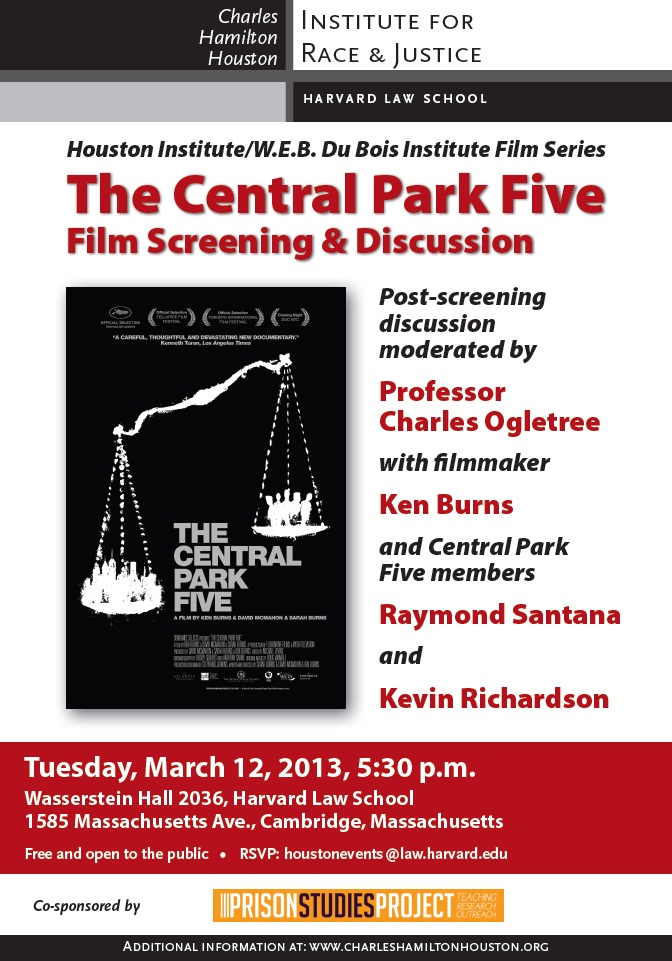
Revisiting the Tragedy of the Central Park Five

You might want to check out this film if you're in the area, a film reviewed here by The New York Times: The Central Park Five revisits two New York nightmares. The first and most famous was the rape and beating of a 28-year-old white woman who, very early on April 20, 1989, was found in Central Park bound, gagged, nearly naked and nearly dead, her head crushed and shirt soaked in her blood. For years she was known only as the Central Park jogger, and her assailants were widely thought to be the five black and Latino teenagers, 14 to 16, who were arrested in the attack. The directors Ken Burns, David McMahon and Sarah Burns argue that the convictions, and the years the defendants served for the crime they were later absolved of, were a second, racially motivated crime."

I have to say I love Ken Burns but had a very mixed reaction to the book by Sarah Burns:  The Central Park Five:  A Chronicle of a City Wilding.  For me, it was well researched but she didn't retell the story in a way that hold my interest.  It's a tragic story, an infuriating story but the human face just didn't come through for me.

I am betting a discussion after the film with Burns, Ogletree and two of the actual accused will certainly put a face to the story.  Check your local listings to see when this film might hit your area.

The Battle to Bring Back Pell Grants for Prisoners

Recently there’s been a more visible push to bring back federal funding for college classes in prison. Here's why you would sleep better if that happened.  Check out my new blog and click on:    


You also might be interested in this editorial in the Seattle Times which just came out today about bringing back higher education funding for prisoners.                     

All SNITCHed Up

It’s not the fast-paced car chases, the explosions, or the careening out of control that impressed me about SNITCH; it’s the heartbreaking story about a father’s desperate attempt to save his son who is embroiled in the horror of mandatory minimum sentences.  And for that, everyone who sees the movie will get a visceral education.

Dwayne Johnson is surprisingly good as a father who is estranged from his son (Rafi Gavron) and discovers that the naive kid agrees to accept a package of drugs for his best buddy who wants to sell them around school.  The boy protests but he’s not strong enough to stand up for himself at this point, battered by a difficult divorce and furious at his father for abandoning him.  But when the brown paper package arrives at his house, I found myself screaming at the screen, “Don’t open the package!” –that’s how believable the scene was.  Of course he does, and of course the buddy has been set up.  A chase, bedlam, the boy is caught and imprisoned and given a mandatory minimum sentence of years and years behind bars.  Only the federal prosecutor can lower the sentence.

The two become close as the father (with the bland last name of  “John Matthews” who could of course be “Everyman”) discovers that the only way he can get his son’s sentence reduced is to bring the prosecutor a high level drug dealer.  She, of course, makes him go beyond what he promises and therein lies the excitement and terror of the story.

But the scenes between the father and his son who is being mistreated behind bars — beaten up for sure and God knows what else as it’s all implied- are what made me realize the depth of the snitch problem.  Who wouldn’t do anything to save his kid?  Who wouldn’t inform on friends or drive trucks across the border to get a break in draconian drug sentencing?  The idea that you shouldn’t snitch is ingrained in the boy who refuses to rat out his friends but how can a father refuse?

For those who criticized casting directors for choosing Dwayne Johnson, I beg to disagree.  I was surprised that he was so convincing.  But it seemed pretty plausible to me that someone who looks and acts like The Rock would be about the only thing that could coerce a Mexican drug cartel into believing he was on the up and up.

Other actors are also fantastic in this film.  Barry Pepper plays an enforcer working for the government who is the only one with a conscience. John Berenthal from The Walking Dead  plays a former low-level drug dealer who is trying desperately to stay out of the game and gets caught up again because of money.  If you were offered $20,000 in this day and age, what would you be willing to do, the film poses. He gets us into the grimy side of drug dealing and into the world of the kingpins where the wonderful Michael K Williams (The Wire) and interestingly-cast Benjamin Bratt (Law and Order) reign. The impossibly driven and mostly heartless Federal prosecutor played to perfection by the always-amazing Susan Sarandon.  And Ravi Gafron as Matthews’s son Jason has the perfect innocence and childlike despair for the role.

See it and enjoy the action.  Read my other blog about Snitch and the tragedy facing so many who make mistakes when they’re young and get incarceration rather than treatment.  And then remember that “48.7%” of those who were convicted of a drug crime carrying a mandatory minimum receive 10 years or more.

Theatre of Witness– A Model of Performance

A new book by Teya Sepinuk Theatre of Witness: Finding the Medicine in Stories of Suffering, Transformation and Peace debuts this week.  It tells the story of those whose stories are often not told.  Taking the beauty and suffering of those we call "the great unwashed," Sepinuk mines the truths of refugees, immigrants, survivors and perpetrators of domestic abuse, ex-combatants, members of the security forces, teenage runaways, prisoners and their families, people living in poverty or without homes, families of murder victims, women in transition, people in recovery and survivors of war."  She also tells her tale and reveals how she developed her techniques and philosophy.

Theatre of Witness is a model of performance, first developed in 1986 that gives voice to those whose worlds are not on the front pages. According to their website  "the true, life stories, of people from diverse backgrounds are performed by people themselves, so that audiences can collectively bear witness to issues of suffering, redemption and social justice."  Techniques include spoken word, music, movement and cinematic imagery, but all "put a face and heart to societal issues of suffering, and celebrate the power of the human spirit to grow and transform."


Two productions/productions to-be fascinate me the most of the over 40 that Sepinuk has created in her many years as a theatre artist.  One is Release which deals with men who are coming to terms with the legacy of their past in Northern Ireland. The show includes a former prison governor, a former detective, a former British soldier, two ex-prisoners and a man who had been blown up in a car bomb as a child.  The production toured Ireland through November, 2012, and will tour internationally during 2013. A documentary will be released of the show as well, premiering in April, 2013.  See the website for details.

The other show I'd love to see, Women and War ,will bring survivors of war from countries such as Rwanda, Afghanistan, Sri Lanka, Cambodia, Bosnia, Serbia, Iraq, Gaza, Israel, Sudan, East Timor and Northern Ireland.beyond Northern Ireland together to share their struggles of building peace in the aftermath of conflict .  What an amazing idea, to forge such a community and have these woman create theatre together.

A book launch in the U.S. will occur in Philadelphia on April 25th and early reviews are great:  "“If you have any doubts about the power of socially-engaged theatre to challenge and heal, the stories and reflections in Theatre of Witness should put them to rest,” said Howard Zehr, professor of Restorative Justice, Center for Justice & Peacebuilding at Eastern Mennonite University.